Open Today Sales: 8:30 AM-7 PMOpen Today Service: 7 AM-6 PMOpen Today Collision Center: 7:30 AM-5:30 PM
← Drag to scroll →
Toyota Land Cruiser vs. 4Runner Comparison |
||
|---|---|---|
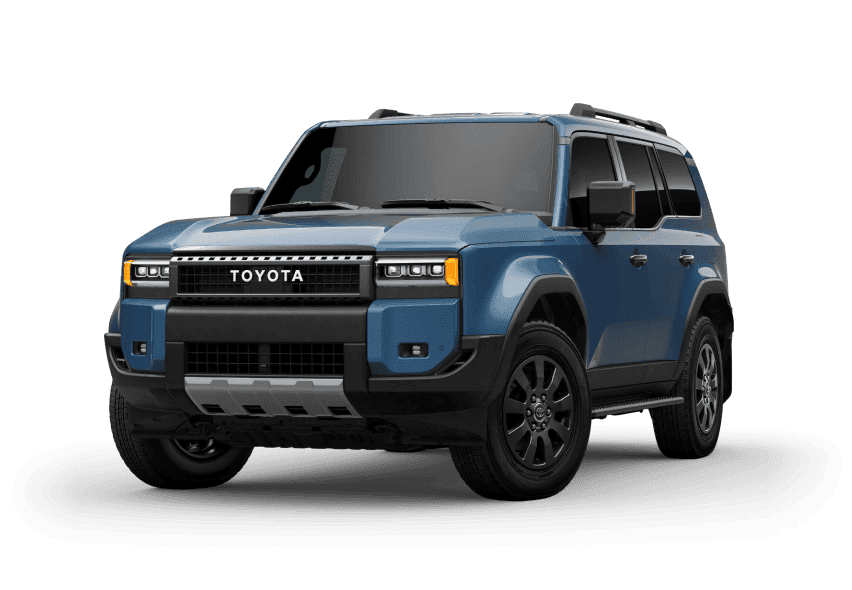 |
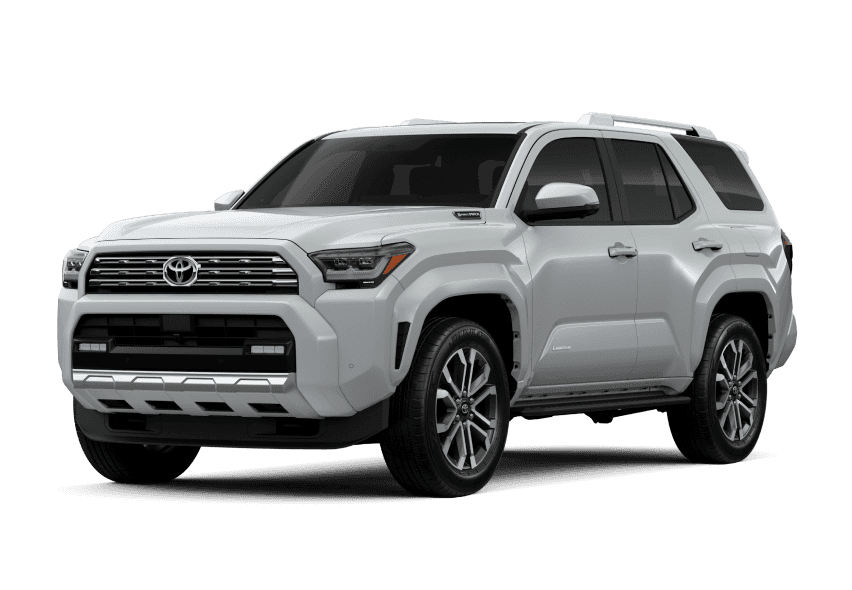 |
|
| 2026 Toyota Land Cruiser | 2026 Toyota 4Runner | |
| Engine | 2.4L turbo 4-cyl i-FORCE MAX |
|
| Horsepower | 326 |
|
| Torque | 465 lb-ft |
|
| Transmission | 8-speed automatic | 8-speed automatic |
| Drivetrain | Full-time 4WD |
|
| Quickest 0-60 | 7.7 sec1 | 7.5 sec1 |
| Max EPA-Est. MPG (Cty / Hwy) | 22 / 252 |
|
| Fuel Tank Size | 17.9 gal | 19 gal |
| Dimensions (Length / Width / Height) | 193.8 / 77.9 / 76.1 in | 194.9 / 77.9 - 79.9 / 72.6 - 74 in |
| Seating Capacity | 5 | 5 - 7 |
| Base Curb Weight | 5,038 lbs | 4,455 lbs |
| Cargo Space Behind 1st Row | 82.2 cu ft | 82.6 - 90.2 cu ft |
| Cargo Space Behind 2nd Row | 46.2 cu ft | 42.6 - 48.4 cu ft |
| Cargo Space Behind 3rd Row | N/A | 12.1 cu ft |
| Max Towing Capacity | 6,000 lbs3 | 6,000 lbs3 |
| Ground Clearance | 8.7 in | 8.1 - 10.1 in |
| Approach Angle | 32 deg | 18 - 33 deg |
| Standard Interior Features |
|
|
| Standard Exterior Features |
|
|
| NHTSA Safety Score | 4/54 | 4/54 |
| New Vehicle Limited Warranty | 3 yr / 36,000 mi5 | 3 yr / 36,000 mi5 |
| 2026 Toyota Land Cruiser | 2026 Toyota 4Runner | |
If you're aching for exceptional capability from your SUV, this Toyota Land Cruiser vs. 4Runner comparison is exactly what the doctor ordered. At Haley Toyota of Roanoke, we like to help our customers find their best-fit vehicle. Below, we dive into the performance, dimensions, adventure-focused attributes, and interiors of these popular Toyota models to pinpoint yours.
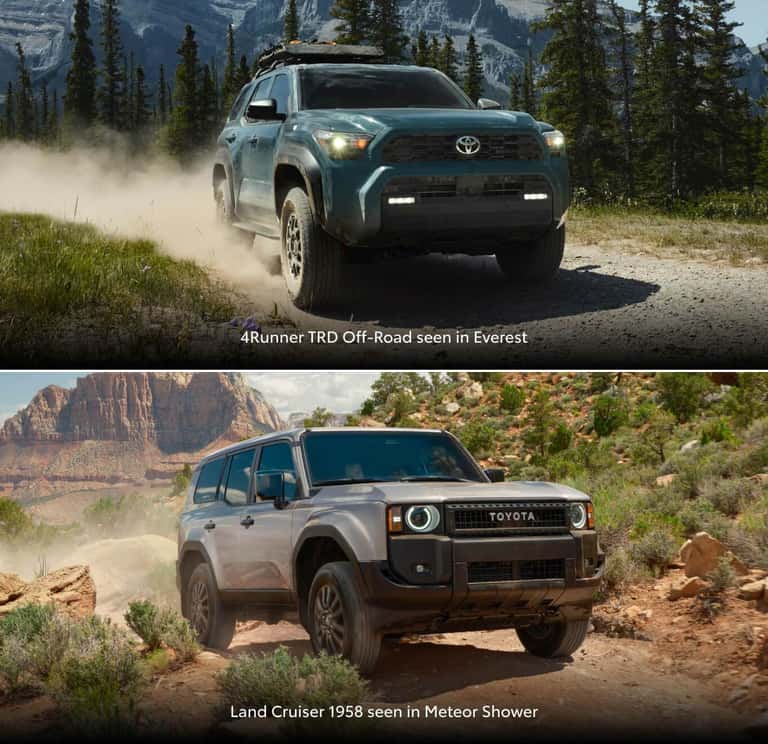
The 4Runner offers a lower starting price point and more configuration options. The Land Cruiser has a higher starting MSRP and fewer configurations.
By the numbers, the 2026 4Runner has the most accessible price in this matchup, which makes sense, since it offers 12 trims. Its performance also ranges from practical to off-road. In contrast, the 2026 Land Cruiser offers two refined trim options and is always trail-ready.
As for configurations, the 4Runner offers a dozen trims, two engines, and three drivetrains. Meanwhile, the Land Cruiser has two trims, one engine, and one drivetrain. Both vehicles, however, provide numerous color options and can be fitted with a long list of upgrades.
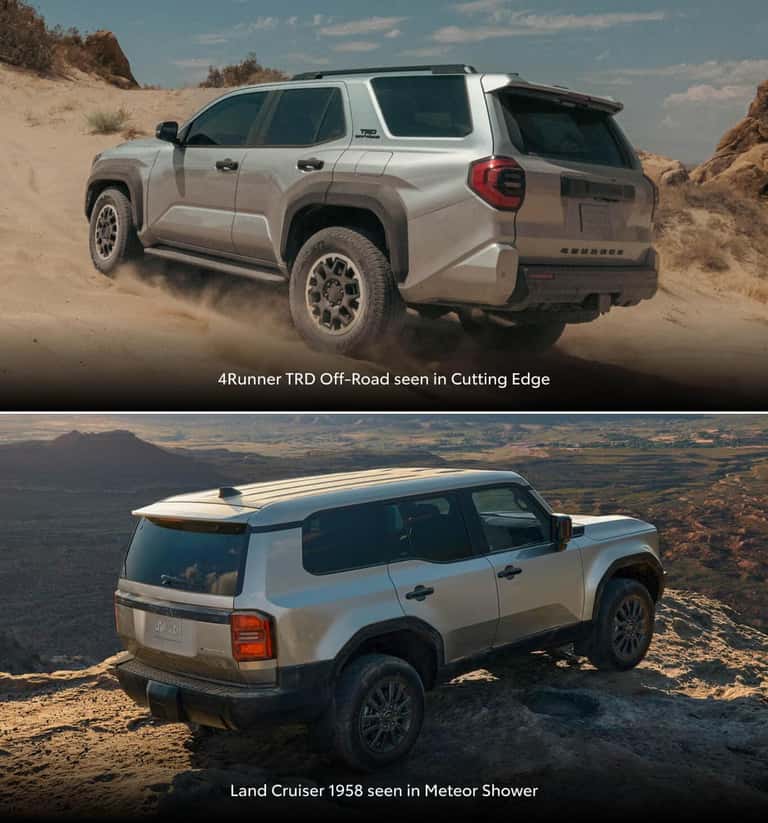
The 4Runner features both gas and hybrid engine options, while the Land Cruiser only has a hybrid engine.
Though they're both body-on-frame SUVs with identical maximum towing specs (feel free to reference our Toyota 4Runner towing capacity guide or contact us for details on Land Cruiser towing), the 4Runner and Land Cruiser offer slightly different performance levels. The 4Runner model's gasoline engine delivers 278 horsepower and 317 pound-feet of torque. It also comes standard with RWD; an upgrade is required to obtain 4WD. The available hybrid engine puts out 326 horsepower and 465 pound-feet of torque.
The Land Cruiser is hybrid-only yet extremely capable with standard full-time 4WD, meaning efficiency and adventure are always top of mind. This SUV produces 326 horsepower and 465 pound-feet of torque standard. The Toyota Land Cruiser and Toyota 4Runner MPG figures are competitive, but the Land Cruiser has a higher standard rating, and the 4Runner has a larger fuel tank.
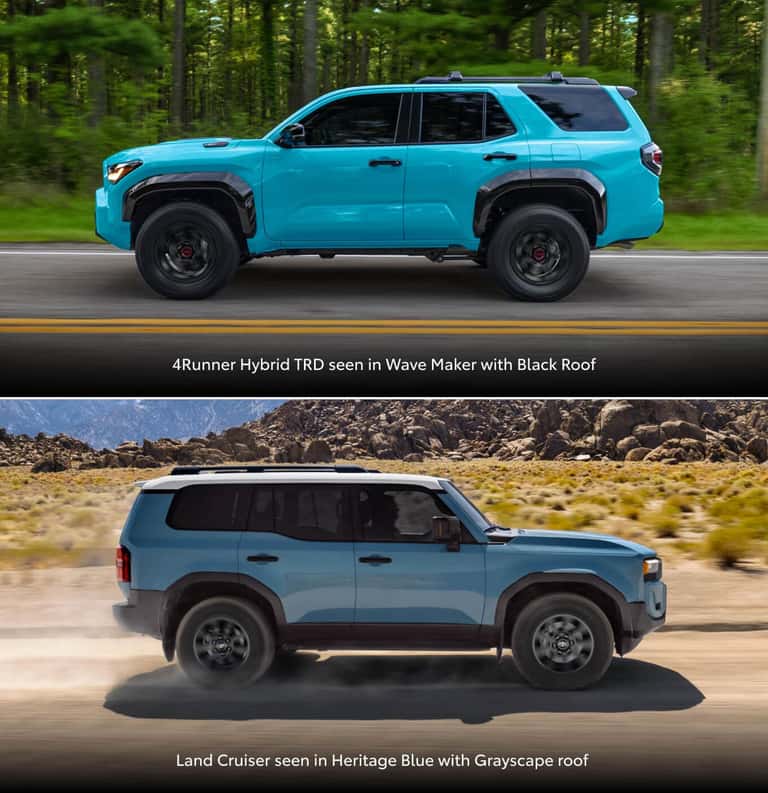
Exterior dimensions are similar between the Toyota Land Cruiser vs. 4Runner. There's more variance in the cabin, with the 4Runner offering two or three rows and the Land Cruiser two rows only, though the latter boasts additional passenger room.
The 4Runner is 1.1 inches longer than the Land Cruiser, and it can be up to 2 inches wider. However, the Land Cruiser is taller overall. The 4Runner has the edge in ground clearance, reaching up to 10.1 inches vs. 8.7 inches for the Land Cruiser. Depending on trim, the 2026 4Runner offers a larger total cargo area. Though, the Land Cruiser has more standard cargo room.
The 2026 Land Cruiser boasts the most spacious cabin for passengers: Legroom is 43 inches up front and 36.7 inches in the second row, compared to 41.8 and 34.8 inches, respectively, in the 4Runner. You'll also enjoy more headroom throughout the Land Cruiser, plus slightly more hip and shoulder room.
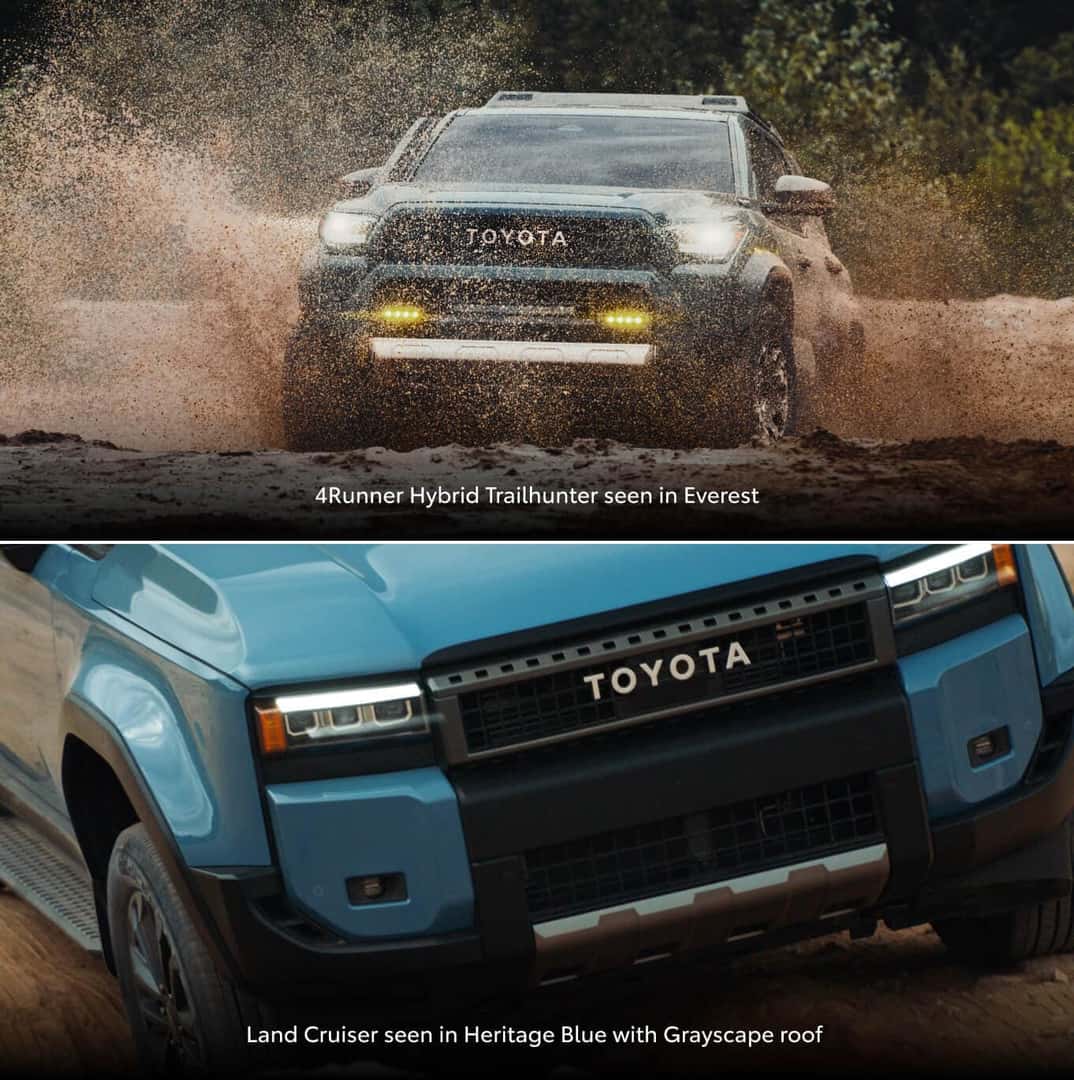
Ferocious off-roading capability comes standard in the Land Cruiser. Select 4Runner trims offer a similar experience.
So you're ready to take the road less traveled – but which Toyota SUV should come with you? The Land Cruiser is prepared to tackle steep hills and boulder-covered paths thanks to its full-time 4WD, Crawl Control, Downhill Assist Control, center and rear locking differentials, and Multi-Terrain Select; it can handle dirt, sand, rocks, and snow with ease.
By comparison, the 4Runner is more comfortable when overlanding on gentler, yet still exciting, terrain. Its higher maximum ground clearance is certainly a win, but many of the standard Land Cruiser features are only offered as available, such as Crawl Control and Downhill Assist Control. It's also standard with RWD. Both SUVs have a Multi-Terrain Monitor available.
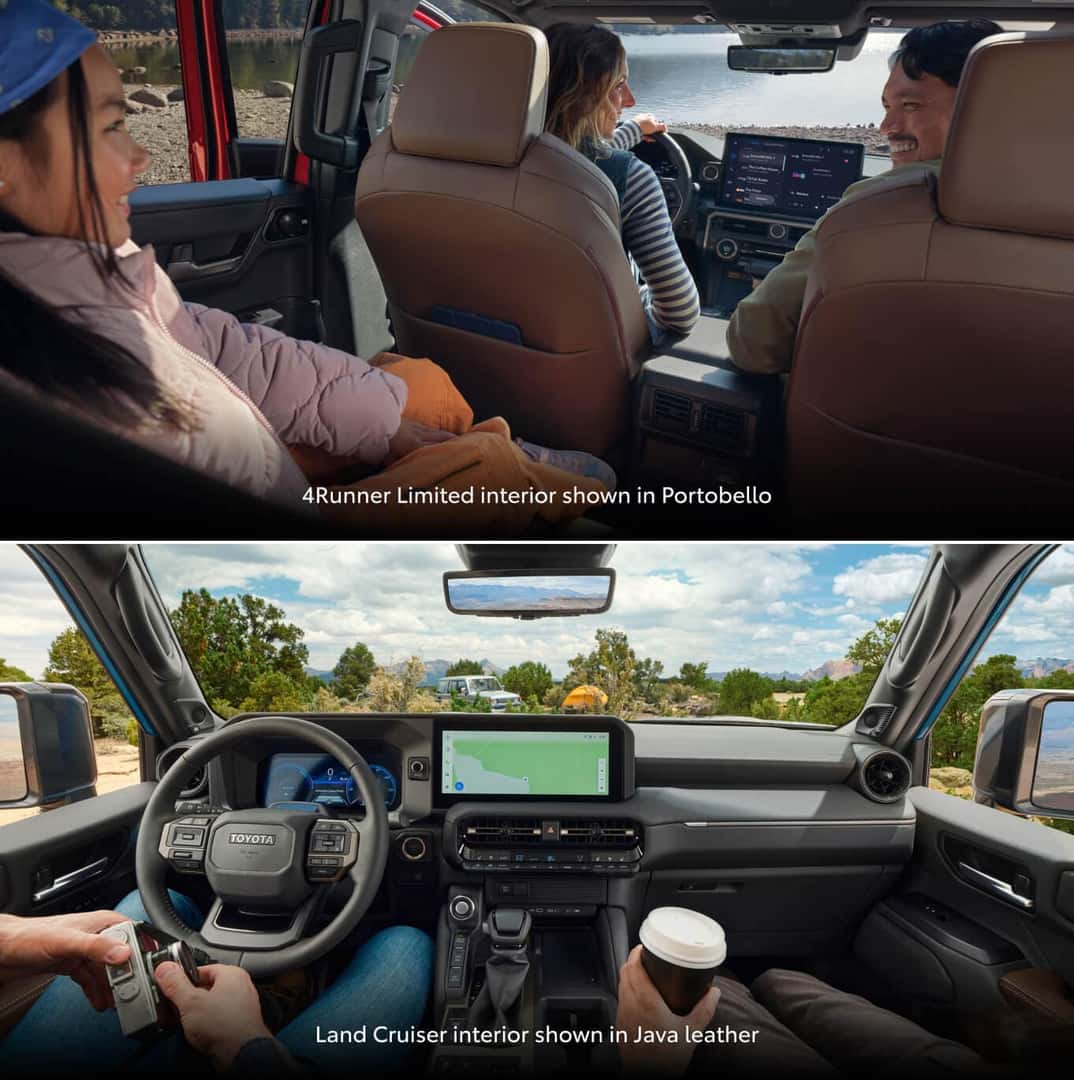
Take home a 4Runner if practicality is your priority; choose a Land Cruiser for a more premium cabin.
Toyota Land Cruiser vs. 4Runner interiors are geared toward different driver personas. Inside the 4Runner, aesthetics lean rugged and utilitarian but with hints of luxury. Single-zone manual climate control is standard, but so is a leather-trimmed steering wheel. Fabric upholstery outfits the first two 4Runner trims, with SofTex and leather joining the party as you move through the lineup.
The Land Cruiser has extreme all-terrain capabilities, but by the look of its cabin, you'd never know it. Streamlined and regal, the Land Cruiser interior is everything you'd expect from a luxury SUV. Three-zone climate control and heated front seats are a given, and the second trim level adds front-row ventilation along with an optional moonroof.
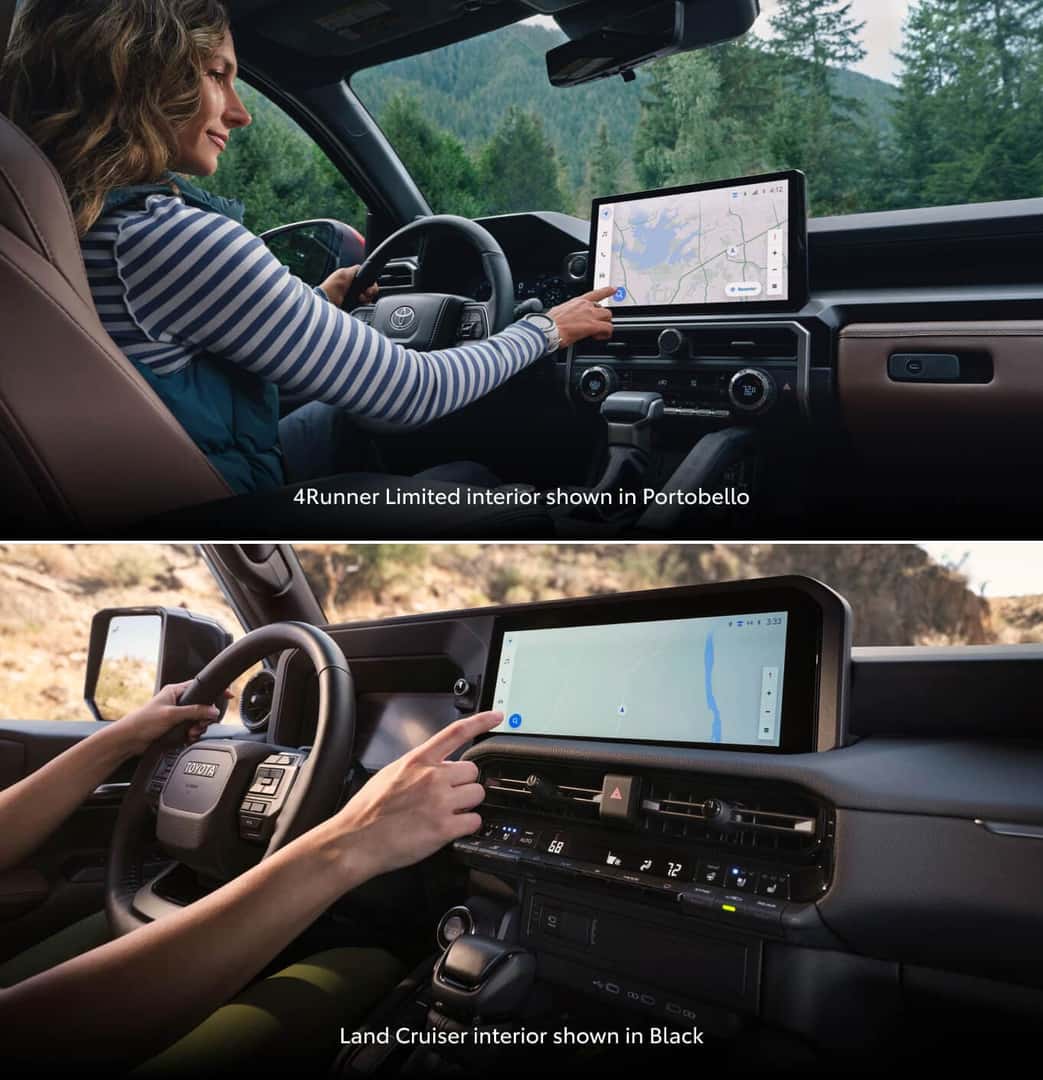
Land Cruiser and 4Runner cabin technology is nearly identical, though the Land Cruiser does have a few higher-grade standard features.
Although Toyota Land Cruiser vs. 4Runner interiors may play to different audiences, their technologies are quite similar. For example, the new Toyota 4Runner for sale comes equipped with an 8-inch touchscreen, wireless Apple CarPlay®, and wireless Android Auto™ – upscale basics for relaxed travel.
New Toyota Land Cruiser infotainment technology is the same, but this SUV takes your standard comfort and convenience a step further with six USB ports, an auto-dimming rearview mirror with HomeLink®, a 12-volt AC power outlet, and a 2400-watt AC inverter. Upper 4Runner and Land Cruiser trims both offer wireless charging, a larger touchscreen, a Head-Up Display, and a 14-speaker JBL® audio system.
Haley Toyota of Roanoke proudly carries both the 4Runner and the Land Cruiser, making it easier than ever to compare these two rugged machines and find your favorite.
No matter which vehicle has your heart, you can visit us to take a test drive and discuss Toyota Land Cruiser and Toyota 4Runner lease deals, or ask about our competitive finance packages.
The 4Runner is longer than the Land Cruiser, but the latter is taller. In standard configurations, they are the same width, but the 4Runner can be up to 2 inches wider. Furthermore, the 4Runner offers higher maximum ground clearance, and some trims feature three rows of seating.
The Land Cruiser and 4Runner are designed for different types of off-roading: The Land Cruiser shines on rock-laden paths and steep hills, while the 4Runner is a great companion on muddy or rocky trails.
Both the Land Cruiser and 4Runner are fantastic family vehicles, offering ample passenger and cargo space, advanced tech, and cutting-edge safety, though with some variances. And if you need three-row seating, the 4Runner is your only option.
1Reference to this third-party review/claim is solely for informational purposes and not to be relied upon. For more details, please visit https://www.caranddriver.com/compare/toyota-4runner-vs-land-cruiser.
2Use for comparison purposes only. Your mileage will vary for many reasons, including your vehicle's condition and how/where you drive. See www.fueleconomy.gov.
3Before towing, confirm your vehicle and trailer are compatible, hooked up and loaded properly and that you have any necessary additional equipment. Do not exceed any Weight Ratings and follow all instructions in your Owner's Manual. The maximum you can tow depends on base curb weight plus the total weight of any cargo, occupants, and added vehicle equipment. "Added vehicle equipment" includes additional standard/optional equipment and accessories added by the manufacturer, dealers, and/or vehicle owners. The only way to be certain of your vehicle's exact curb weight is to weigh your vehicle without passengers or cargo. (Calculated with the new SAE J2807 method.) Installation of a tow hitch receiver or other accessories located near the rear bumper or side-door kick sensors may require disabling or removing the kick sensor, and the sensor operation setting in your vehicle should be turned off. See Owner's Manual for limitations.
4Reference to this third-party claim is solely for informational purposes and not to be relied upon. For details regarding this rating, visit https://www.nhtsa.gov.
5Whichever time/mileage designation comes first. Warranties listed on this web page shall not be solely relied upon. Warranties may be subject to specific terms, restrictions, exclusions, and fees. Additional warranty information may be obtained by visiting the official website of the warranty provider. Contact our dealership for complete details.