Sales: ClosedService: ClosedCollision Center: Closed
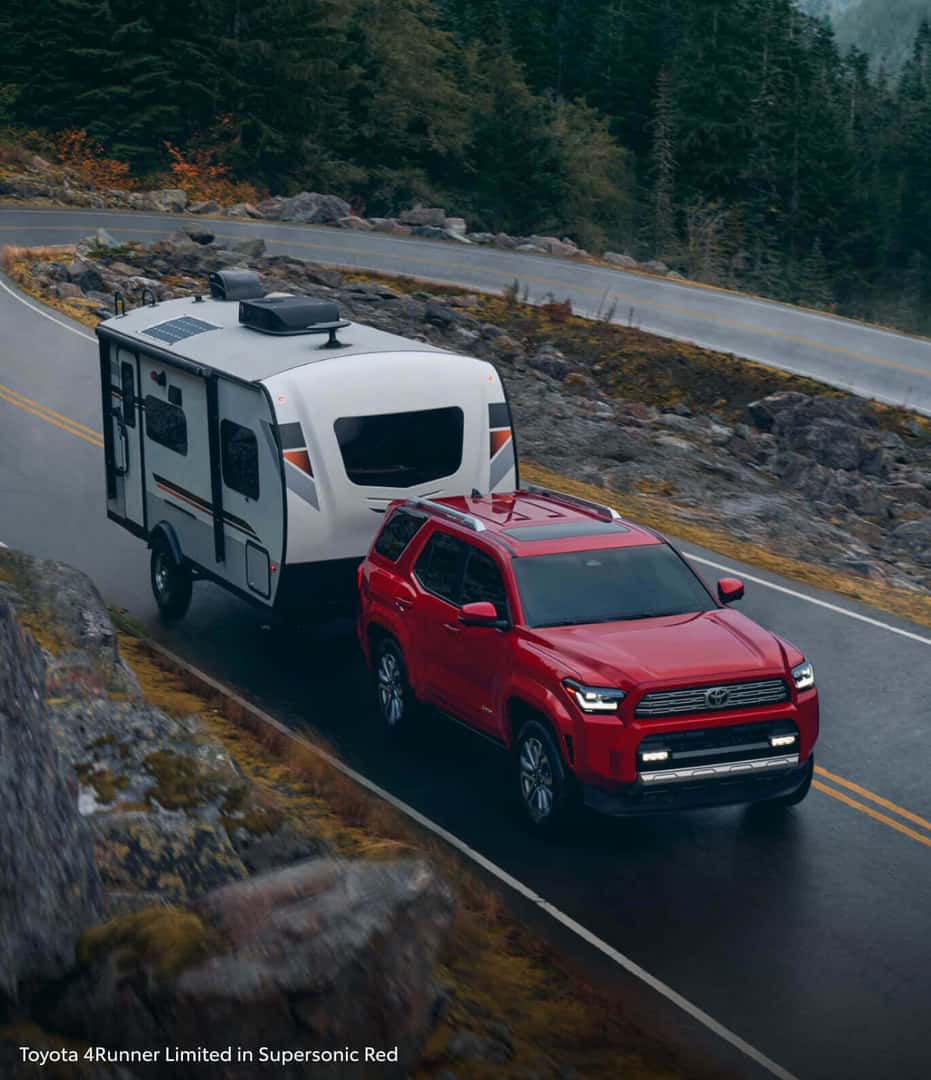
The 2026 Toyota 4Runner can tow up to 6,000 pounds,1 making it a powerful choice for hauling boats, campers, or trailers on your next adventure. This Toyota 4Runner towing capacity gives drivers the confidence to tackle both work and weekend trips while enjoying the SUV’s rugged capability and everyday practicality.
Alongside exceptional off-roading features like the new Stabilizer Disconnect Mechanism or TRD-tuned FOX® suspension, you can bring your favorite recreational toy right to your favorite site – and an available third row of room brings the whole family with you. At Haley Toyota of Roanoke, we're huge fans of SUVs with the utility to turn your vacation into something special and memorable, and the sixth generation of the legendary Toyota 4Runner has the grit to revolutionize your adventures.
Before exploring the Toyota 4Runner towing capacity, let’s take a look under the hood at the powertrains that make it possible. The lineup begins with the i-FORCE 2.4-liter turbocharged engine, delivering 278 horsepower and 317 pound-feet of torque. For those seeking even more muscle, the i-FORCE MAX 2.4-liter turbocharged hybrid engine boosts output to 326 horsepower and 465 pound-feet of torque. The hybrid comes standard on the top-tier Platinum, TRD Pro, and Trailhunter trims, while remaining an available option on the TRD Off-Road, TRD Off-Road Premium, and Limited models.
To see just how far-reaching this new 6,000-pound1 2026 Toyota 4Runner towing capacity is, see the chart for applicable trims.
| SR5 | TRD Sport | TRD Sport Premium | TRD Off-Road | TRD Off-Road Premium | Limited | Platinum | Trailhunter | TRD Pro | |
|---|---|---|---|---|---|---|---|---|---|
| Best Engine(s) For Towing | 2.4L i-FORCE Turbo 4-Cyl | 2.4L i-FORCE Turbo 4-Cyl | 2.4L i-FORCE Turbo 4-Cyl |
|
|
|
2.4L i-FORCE MAX Hybrid | 2.4L i-FORCE MAX Hybrid | 2.4L i-FORCE MAX Hybrid |
| Max. Towing Capacity | 6,000 lbs1 | 6,000 lbs1 | 6,000 lbs1 | 6,000 lbs1 | 6,000 lbs1 | 6,000 lbs1 | 5,800 lbs1 | 5,800 lbs1 | 5,800 lbs1 |
| Drivetrain | RWD / 4WD | RWD / 4WD | RWD / 4WD | 4WD | 4WD | RWD / 4WD | 4WD | 4WD | 4WD |
As shown in the chart above, the 2026 Toyota 4Runner can achieve its maximum 6,000-pound towing capacity1 with RWD or 4WD and the standard i-FORCE 2.4-liter engine or the i-FORCE MAX hybrid setup. With this capability offered across multiple trims and configurations, you have plenty of options to match a 4Runner to your budget, drivetrain preference, and desired interior features without sacrificing hauling ability.
You may notice a slight dip in the 4Runner tow capacity as you move up the lineup, with the Platinum, Trailhunter, and TRD Pro reaching a height of 5,800 pounds.1 This small decrease is due to the added weight of factory-installed off-road equipment, specialized suspensions, and other upscale features.
While the 2026 no doubt provides a noteworthy towing ability, as did the previous model (which marked the best max 4Runner tow rating in the last 15 years), this modern generation isn't the most potent vehicle in the SUV's history. While the fifth-gen 4Runner towing capacity stayed steady at 4,700 to 5,000 pounds,1 this Toyota SUV reached its trailering peak in its fourth generation.
Check out our year-by-year chart to see how towing capacity has evolved, along with the engines and drivetrains that allow each model year to reach its maximum towing potential. Remember that these figures can vary based on trim level and equipment.
| Generation | Best Engine(s) For Towing | Drivetrain | Max. Towing Capacity | |
|---|---|---|---|---|
| 1984 | 1st Gen | 2.4L I-4 | 4WD | 2,500 to 3,000 lbs 1 |
| 1985 | 1st Gen | 2.4L I-4 | 4WD | 2,500 to 3,000 lbs 1 |
| 1986 | 1st Gen | 2.4L I-4 | 4WD | 3,500 lbs 1 |
| 1987 | 1st Gen | 2.4L I-4 | 4WD | 3,500 lbs 1 |
| 1988 | 1st Gen | 3.0L V-6 | 4WD | 3,500 lbs 1 |
| 1989 | 1st Gen | 3.0L V-6 | 4WD | 3,500 lbs 1 |
| 1990 | 2nd Gen | 3.0L V-6 | 4WD | 3,500 lbs 1 |
| 1991 | 2nd Gen | 3.0L V-6 | 4WD | 3,500 lbs 1 |
| 1992 | 2nd Gen | 3.0L V-6 | 4WD | 3,500 lbs 1 |
| 1993 | 2nd Gen | 3.0L V-6 | 4WD | 3,500 lbs 1 |
| 1994 | 2nd Gen | 3.0L V-6 | 4WD | 3,500 lbs 1 |
| 1995 | 2nd Gen | 3.0L V-6 | 4WD | 3,500 lbs 1 |
| 1996 | 3rd Gen | 3.4L V-6 | 4WD | 5,000 lbs 1 |
| 1997 | 3rd Gen | 3.4L V-6 | 4WD | 5,000 lbs 1 |
| 1998 | 3rd Gen | 3.4L V-6 | 4WD | 5,000 lbs 1 |
| 1999 | 3rd Gen | 3.4L V-6 | 4WD | 5,000 lbs 1 |
| 2000 | 3rd Gen | 3.4L V-6 | 4WD | 5,000 lbs 1 |
| 2001 | 3rd Gen | 3.4L V-6 | 4WD | 5,000 lbs 1 |
| 2002 | 3rd Gen | 3.4L V-6 | 4WD | 5,000 lbs 1 |
| 2003 | 4th Gen | 4.7L V-8 | 4WD | 5,000 lbs 1 |
| 2004 | 4th Gen | 4.7L V-8 | RWD | 7,300 lbs 1 |
| 2005 | 4th Gen | 4.7L V-8 | RWD | 7,300 lbs 1 |
| 2006 | 4th Gen | 4.7L V-8 | RWD | 7,300 lbs 1 |
| 2007 | 4th Gen | 4.7L V-8 | RWD | 7,300 lbs 1 |
| 2008 | 4th Gen | 4.7L V-8 | RWD | 7,300 lbs 1 |
| 2009 | 4th Gen | 4.7L V-8 | RWD | 7,300 lbs 1 |
| 2010 | 5th Gen | 4.0L V-6 | Part- or Full-Time 4WD | 5,000 lbs 1 |
| 2011 | 5th Gen | 4.0L V-6 | Part- or Full-Time 4WD | 5,000 lbs 1 |
| 2012 | 5th Gen | 4.0L V-6 | Part- or Full-Time 4WD | 5,000 lbs 1 |
| 2013 | 5th Gen | 4.0L V-6 | Part- or Full-Time 4WD | 5,000 lbs 1 |
| 2014 | 5th Gen | 4.0L V-6 | Part- or Full-Time 4WD | 4,700 lbs 1 |
| 2015 | 5th Gen | 4.0L V-6 | Part- or Full-Time 4WD | 4,700 lbs 1 |
| 2016 | 5th Gen | 4.0L V-6 | Part- or Full-Time 4WD | 5,000 lbs 1 |
| 2017 | 5th Gen | 4.0L V-6 | Part- or Full-Time 4WD | 5,000 lbs 1 |
| 2018 | 5th Gen | 4.0L V-6 | Part- or Full-Time 4WD | 5,000 lbs 1 |
| 2019 | 5th Gen | 4.0L V-6 | Part- or Full-Time 4WD | 5,000 lbs 1 |
| 2020 | 5th Gen | 4.0L V-6 | Part- or Full-Time 4WD | 5,000 lbs 1 |
| 2021 | 5th Gen | 4.0L V-6 | Part- or Full-Time 4WD | 5,000 lbs 1 |
| 2022 | 5th Gen | 4.0L V-6 | Part- or Full-Time 4WD | 5,000 lbs 1 |
| 2023 | 5th Gen | 4.0L V-6 | Part- or Full-Time 4WD | 5,000 lbs 1 |
| 2024 | 5th Gen | 4.0L V-6 | Part- or Full-Time 4WD | 5,000 lbs 1 |
| 2025 | 6th Gen |
|
RWD or Part / Full-Time 4WD | 6,000 lbs 1 |
| 2026 | 6th Gen |
|
RWD or Part / Full-Time 4WD | 6,000 lbs 1 |
The i-FORCE powertrains are quite capable, but looking back at model years 2004 to 2009, the 4Runner V-8 towing capacity achieves the highest at a 7,300-pound maximum.1 This is significantly greater than the 4Runner V-6 towing capacity of 5,000 pounds1 and a bit more than the most recent generation.
That said, the introduction of the newer engines – particularly the i-FORCE MAX – significantly boosts low-end towing power and enhances overall efficiency for this hefty SUV, all while maintaining the vehicle’s position as having the second-highest maximum towing capacity.
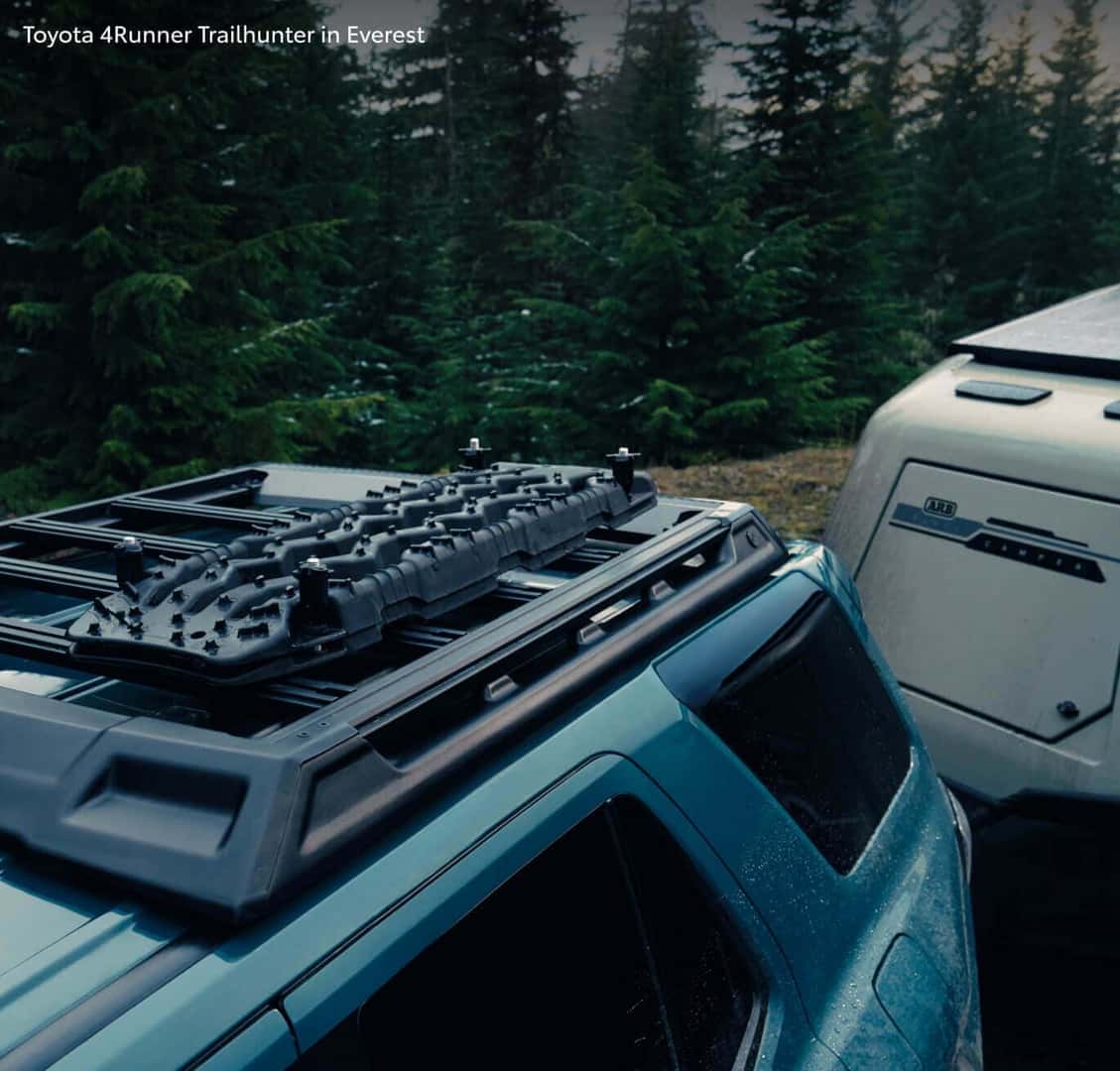
While the 2026 Toyota 4Runner for sale comes with plenty of integrated off-road components and safety features, 4Runner ARB tow equipment is perfect for a busy family vacation.
Keep your tow hitch free of debris and scratches with the help of an OEM-approved hitch cover.
Want to make getting yourself out of trouble easy? A tow ring on the front of your vehicle can help you get out of a ditch – with the help of another friend.
The right-sized 4Runner tow ball from ARB is designed to expand your collection to include utility, boat, and carrier trailers.
Spare tow hooks for your 4Runner are recommended for any problematic trail. These come in handy for attaching recovery gear like straps or chains.
For trailers above a certain weight, please attach the wire harness according to your trailer's installation guide.
Hook up the trailer to your vehicle. Your owner's manual provides more details about the height of your carrying ball or hitch receiver so you can line it up more effectively. Once you are sure it's secure, we recommend wrapping a safety chain around your 4Runner and haul.
Before you take your trailer onto the road, drive it carefully. Practice accelerating, braking, reversing, and turning with a heavier trailer. If you installed the wiring harness, check the integrated lights and brakes.
Now that you know what the Toyota 4Runner towing capacity sounds like on paper, it's time to visit Haley Toyota of Roanoke and take this capable sport-ute for a test ride. We have 2026 models in our showroom and older models in our used Toyota vehicle collection. Whether you're interested in a finance package or starting a Toyota 4Runner lease, our team can help you get behind the wheel of this legendary SUV as soon as possible.
Currently, there is no official 2026 Toyota 4Runner payload capacity. However, you can calculate the payload by subtracting the curb weight and GVWR. For example, the Limited RWD has a curb weight of 4,730 pounds and a GVWR of 6,130 pounds.2 Using the formula, this would give you a payload capacity of 1,400 pounds.3 Contact us for more specific 4Runner specs!
At a towing capacity of 6,000 pounds,1 the 2026 Toyota 4Runner can tow sedans and may be able to bring an off-roading vehicle out of a bad situation. It's not recommended to do this with fifth-generation 4Runners, as 5,000 pounds1 is much closer to the average weight of a vehicle. Consult your owner's manual for more information about the types of automobiles you can tow.
The fourth-generation 4Runners include models capable of towing up to 7,300 pounds.1 Achieving this requires the proper towing kit, the 4.7-liter V-8 engine, and RWD, though 4WD configurations can reach 7,000 pounds when properly equipped. The six-generation 4Runners come close to this benchmark, offering a maximum towing capacity of 6,000 pounds1 with either RWD or 4WD.
Toyota 4Runners from 2004 to 2009, when utilizing the 4.7-liter V-8 engine, RWD, and the standard trailering gear, are capable of the maximum 4Runner towing capacity of 7,300 pounds.1 The next closest generation is the 2025 to 2026 4Runner, with up to 6,000 pounds when properly equipped. Contact us for more information about towing with your 4Runner.
Yes, the 2026 Toyota 4Runner is capable of hauling Jet Skis and light boats. With 6,000 pounds of towing capacity,1 your 4Runner is more than capable of bringing a fishing boat on its trailer, several Jet Skis on a carrier, a bunch of canoes, and more to the waterside for a weekend of getaway bliss. However, drive carefully to avoid trailer tipping while driving to the riverbed.
Yes, a 2026 Toyota 4Runner can haul up to 6,000 pounds when properly equipped, making it well-versed in hauling medium-sized campers. With impressive off-roading specs, such as the TRD-tuned FOX® suspension and off-road gear from ARB, you should be able to get your vehicle right to your campsite without an issue! Before you tow your camper across rough terrain, fasten it securely.
A Toyota 4Runner can tow campers, depending on its model year, engine, and drivetrain. The 2026 4Runner, with a max towing capacity of 6,000 pounds,1 can handle small- to mid-sized travel trailers or pop-up campers. Older fifth-generation models can tow up to 5,000 pounds,1 suitable for lightweight trailers, while fourth-generation V-8 models can reach 7,300 pounds,1 allowing for larger travel trailers.
When towing heavier loads with your 2026 Toyota 4Runner, staying out of the fifth gear ratio is advised. Sport mode and manual shift allow you to cruise in this range as much as possible, reducing strain on your engine. When we have more information about the gear ratios for the sixth-generation Toyota 4Runner, we can give you details on the driving mode and gear selection you should stay in.
When carrying a heavy trailer with your 4Runner, it's recommended that you put as much weight onto the trailer axles as possible. This takes the weight off your trailer tongue and 4Runner chassis, reducing the strain on your frame. For weights above 3,000 pounds, you should get a trailer with two or more axles to help distribute the haul accordingly. For more tips on axle weight distribution, contact us.
1Before towing, confirm your vehicle and trailer are compatible, hooked up and loaded properly and that you have any necessary additional equipment. Do not exceed any Weight Ratings and follow all instructions in your Owner's Manual. The maximum you can tow depends on base curb weight plus the total weight of any cargo, occupants, and added vehicle equipment. "Added vehicle equipment" includes additional standard/optional equipment and accessories added by the manufacturer, dealers, and/or vehicle owners. The only way to be certain of your vehicle's exact curb weight is to weigh your vehicle without passengers or cargo. (Calculated with the new SAE J2807 method.) Installation of a tow hitch receiver or other accessories located near the rear bumper or side-door kick sensors may require disabling or removing the kick sensor, and the sensor operation setting in your vehicle should be turned off. See Owner's Manual for limitations.
2GVWR ratings assume vehicles are properly equipped with manufacturer-recommended towing setups. Actual weight capacities may vary.
3Max payload varies based on accessories and vehicle configuration.